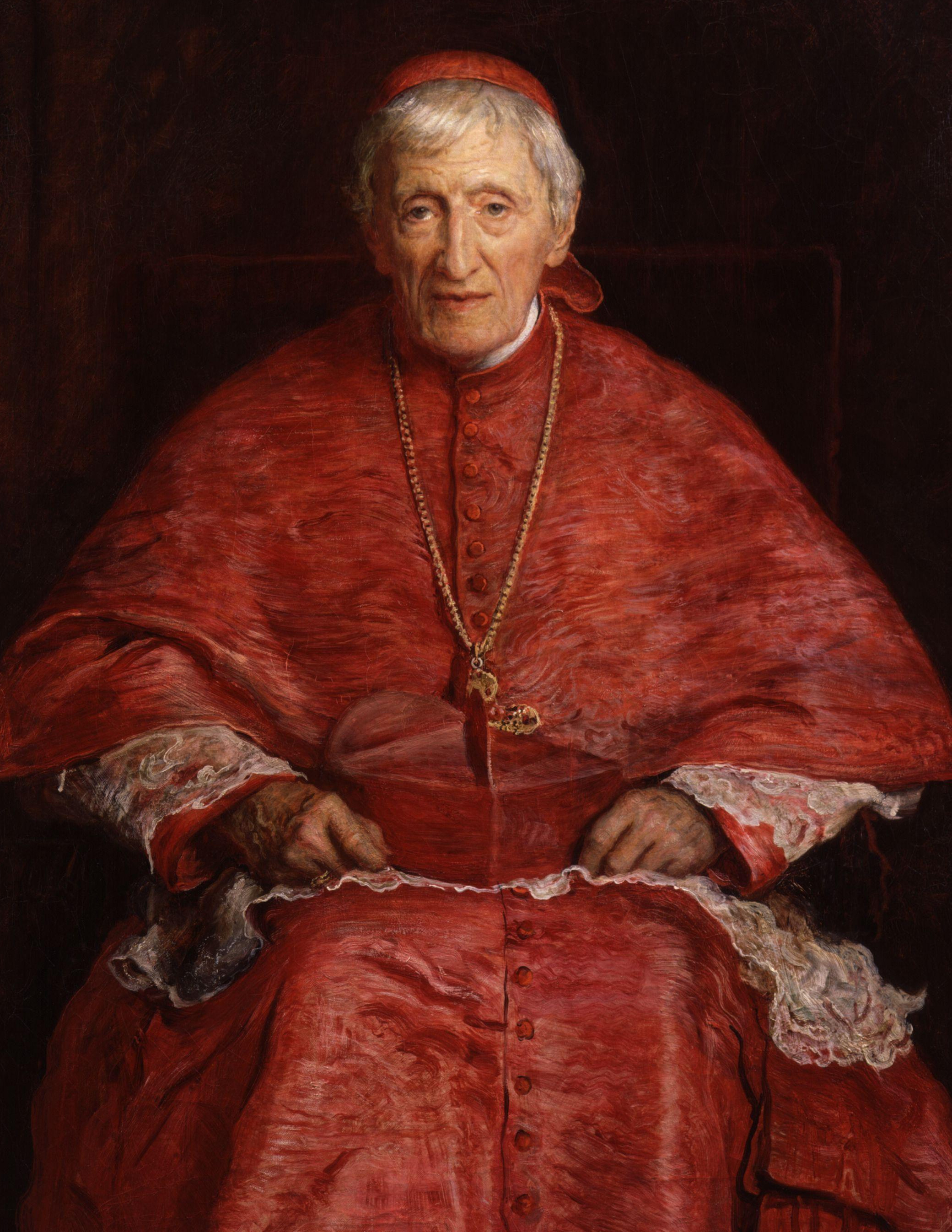
Newman’s influence on the University of Dallas courses through our very bones, by which I mean the curriculum, structure, ethos, and telos of our approach to education. Let me point to just a few of the ways in which Newman influences us:
-
Newman was motivated by the profound conviction that Catholicism and educational excellence go hand in hand. Never did he shirk from calling us both to fidelity and to educational excellence. In our day and age, these are often divorced, even at times at Catholic universities. UDallas exemplifies that the two can co-exist without compromise; that, in fact, a faithful and confident embrace of one’s Catholic identity ought to inspire educational excellence.
-
Newman appreciated both the unity and diversity of the whole field of free studies. Every discipline has its unique purchase on contemplating the truths of the world, and each discipline brings its particular way of seeing the whole. Such respect for particular disciplines also enables progress towards a comprehensive vision of the unity of the various disciplines, a unity of knowledge.
-
Newman defended the role of theology as a legitimate science unto itself. Theology is no pseudoscience, but rather the queen of the sciences. Newman defended the science of theology in a day and age, not unlike our own, in which theology was derided, and his arguments have staying power.
-
Newman appreciated, deeply, that learning for its own sake is its own reward. He was a stalwart defender of the true ends of education against the forces that continue to look to higher education only for its utility value.
-
Newman points us towards the lifelong path of learning. A liberal education is something worthy of a lifetime of growing into.
-
Newman is a profound guide for a fully integrated Catholic education, one that interweaves academics with student life and campus ministry.
-
Newman had a profound devotion to the Eucharist, and writes movingly of the need to cultivate that devotion. It is most fitting that we celebrate this special day with a Eucharistic procession.
Let me conclude with three remarks from Newman. The first is an articulation of the ends of liberal education, the second is a focused reflection on the ends of liberal education as they apply to Catholics, and the third is his most cherished prayer.
From the Idea of a University: “But a university training is the great ordinary means to a great but ordinary end; it aims at raising the intellectual tone of society, at cultivating the public mind, at purifying the national taste, at supplying true principles to popular enthusiasm and fixed aims to popular aspiration, at giving enlargement and sobriety to the ideas of the age, at facilitating the exercise of political power, and refining the intercourse of private life. It is the education that gives a man a clear conscious view of his own opinions and judgments, a truth in developing them, an eloquence in expressing them, and a force in urging them. It teaches him to see things as they are, to go right to the point, to disentangle a skein of thought, to detect what is sophistical, and to discard what is irrelevant. It prepares him to fill any post with credit and to master any subject with facility. It shows him how to accommodate himself to others, how to throw himself in their state of mind, how to bring before them his own, how to influence them, how to come to an understanding with them, how to bear with them. He is at home in any society, he has common ground with any class….”
In a lecture given in 1851 titled “Present Positions of Catholics in England,” Newman wrote:
“What I desiderate in Catholics is the gift of bringing out what their religion is. I want a laity, not arrogant, not rash in speech, not disputatious, but men who know their religion, who enter into it, who know just where they stand, who know what they hold and what they do not, who know their creed so well that they can give an account of it, who know so much of history that they can defend it. I want an intelligent, well-instructed laity. I wish you to enlarge your knowledge, to cultivate your reason, to get an insight into the relation of truth to truth, to learn to view things as they are, to understand how faith and reason stand to each other, what are the bases and principles of Catholicism ….”
Newman’s Prayer, “Mission of My Life,” reveals his heart. Let’s make this prayer our own, focused as it is on the personal vocation each one of us has:
God has created me to do Him some definite service.
He has committed some work to me which He has not committed to another. I have my mission.
I may never know it in this life, but I shall be told it in the next. I am a link in a chain, a bond of connection between persons. He has not created me for naught.
I shall do good; I shall do His work. I shall be an angel of peace, a preacher of truth in my own place, while not intending it if I do but keep His commandments.
Therefore, I will trust Him, whatever I am, I can never be thrown away. If I am in sickness, my sickness may serve Him, in perplexity, my perplexity may serve Him. If I am in sorrow, my sorrow may serve Him. He does nothing in vain.
He knows what He is about. He may take away my friends. He may throw me among strangers. He may make me feel desolate, make my spirits sink, hide my future from me. Still, He knows what He is about.
We thank St. John Henry Newman for his remarkable witness to the faith, his profound defense of authentic Catholic higher education, and for the manner in which he has called each of us to embrace our particular vocation.
St. John Henry Newman, Doctor of the Church and Co-Patron of Catholic Education, pray for us.