Transcript of the Conversation
What follows is an adapted transcript (edited for length and clarity) of the discussion.
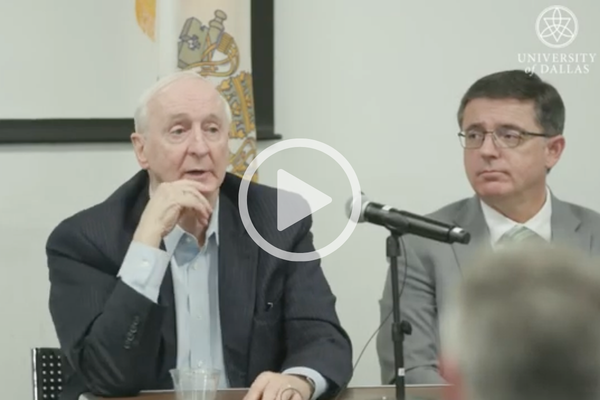
Sanford: It's such a pleasure to sit down with you, Andrew. We've known each other for a long time. You've been a lifelong educator and leader in the classical education space, about 20 years, almost 20 years as a headmaster. And before that, you were just a regular teacher.
Zwerneman: Just a regular teacher.
Sanford: And I was, in fact, the beneficiary of two years of humane letter seminar direction under you, where we worked through at Trinity School at Greenlawn, the great book's curriculum. That's really the hallmark of so much of what's happening within classical education. So it's such a joy to sit down with you today. Thank you for joining me for this conversation.
Zwerneman: Well, thanks for having me. I'm just really honored to be here with you and be here at your beautiful university.
University of Dallas is one of the most important institutions in the country. And I couldn't be more pleased that a former student is heading up the enterprise here. I have great memories of being your teacher. And I'm still a regular teacher. So I still lead seminars from time to time, and I put on lectures and things like that.
That was my calling. I'm glad to call myself a regular teacher.
Sanford: Well, I'm still a regular teacher, too. And it's one of the things that keeps me going in the presidency, is getting into the classroom on occasion.
Remembering what this is all about.
Remembering what this is all about is going to be the main subject of what I want to talk with you about today. You've engaged in a project called History 250. And we're going to get into the details of why you have undertaken this project. I have viewed several of the short films. They are stunning. They're beautiful. They are doing what I think your intention is, at least in me and any other viewer, which is to put before us people of great character, to remind us of our shared history, and to really focus us on the future of the United States of America, as we're embarking on this 250th anniversary.
But before we get into those details, this is a project that is under the umbrella of the Cana Academy. And what is that project?
Zwerneman: That's right. This is our biggest history-related project. Cana Academy was established in 2016.
Two other master teachers and I all retired from the classroom in one respect in that same year. And we decided to throw in our 100-plus years of experience, especially in leading seminars, teaching literature and composition, teaching writing, teaching history, teaching art. We wanted to pump life into the humanities. And we carved out a niche within the classical education movement, especially among secondary teachers and especially among seminar leaders.
We call ourselves Cana Academy. Of course, we're inspired by the story from the Gospel of John about the wedding feast of Cana. Maybe more immediately, we're inspired by that beautiful story within the Brothers Karamazov at Dostoyevsky.
The main protagonist, Alyosha, experienced a personal crisis at every level. When his mentor, Father Zalima, passed away, he was particularly in a critical state. And he experienced a dream version of the wedding feast of Cana. And coming out of that, he went outside, looked into the heavens, and he threw himself with the ground in a very Russian fashion, seemingly in an inadequate response to the grandeur and the mystery of the cosmos.
But it's entirely purposeful, meaningful. It's exactly what he should have done. And then he got up and said, I know what to do now. I know how to relate to my crazy father, my complicated brothers, and they're very complicated women. And I know how to take care of the boys who were lost in town. So he found his way. So what we wanted to do is provide a source of renewal. We wanted teachers especially to get support, to have allies who were fellow regular teachers and in our work in training the teachers-- and we've trained over 5,000 teachers over the last 10 years-- and in all the services and products that we provide. Some of them are free. Some of them are for sale.
So we created this website, Cana Academy, and this mission in order to pump life into the humanities.
Sanford: Well, it's an inspiring work that you're engaged in. And it's fueling, really, a resurgence of genuine education in this country. So thank you for your vision, your leadership, and the work you've done with so many teachers, 5,000 teachers. That's just remarkable. So why this project? Why the History 250 series?
Zwerneman: I co-founded Cana Academy, expecting that most of what we would do has to do with humane letter seminars.
And in one respect, that's true. That's kind of our bread and butter offering. But the more I traveled the country, the more I kept running into teachers who were disconcerted about history. Either they didn't really understand what history is, or they were kind of rocked by the mounting anti-history culture in America, particularly under the influence of the Howard Zinn Education Project and his most oft-read book, People's History of the United States, under the 1619 Project, under other DEI voices. They increasingly felt like we couldn't say anything positive or even true about the American past, other than, say, America as a land of oppression. So they were afraid that all they could do is speak to grievances.
And this is really off. This is unproductive, it's uncreative, and it's untrue to the past. Even a cursory glance at the American past, the Western past, the Christian past, there are all sorts of great things that have happened. And the only way to measure a failure, like slavery or Indian removal or Japanese internment or something like that, is to measure by what is truly good. So I wrote a little book, History Forgotten and Remembered, and then of late, I decided we're going to try to pump into the renewal of history, we're going to pump 250 short films and all sorts of support services. So we have a big bank of films that we're building. We have an equally big bank of original documents and maps that support the teaching of history. But we also wanted this to be not just a renewal of how we teach history in the schools, we wanted it to be a renewal of how Americans think about their past.
You and I are living today, the past has a big pull on us.
We can't experience directly what our forebears, our ancestors, experienced. The only way we can live as one with our ancestors is under history. We have to have a shared story about our shared past. And I'm dedicated to helping people grasp that once more and to live under history in that mode. And then in particular, I'm trying to renew the liberal discipline of history. That is, we want to be true to the past, what actually happened. We don't use the past as a call to political action. We study history in order to understand the past, which is different than the present, and also understand ourselves by observing those who came before us.
Sanford: When you say short films, tell us exactly what that means. And what venues you see these short films really having an impact.
Zwerneman: They're short as in between six and eight minutes. So on average, they're around seven minutes.
And we're utilizing what historians utilize. We use imagery as in portraiture and maps. We use data like comparative gross domestic products, demographic changes, and things like that. We use individual and group narratives, and autobiography, say, Frederick Douglass, or eyewitness accounts at a particular event. And then we do some, what historians call structural analysis, that we look at, say, a strategy employed to liberate Europe from the Northwest and to liberate it from the South by way of North Africa, Sicily, and so forth during World War II.
So we're trying to be true to history in that regard. And in the way we structure the films, they kind of train teachers and their students to think that way. The venues are not just schools.
We also are trying to land them in church groups, retirement communities, and senior citizen organizations, American Legion and DFW-Post. We want to be able to access prisons and returning citizen programs. The idea is that anybody who is an American, they should understand our past. We had this in common. It should be a great source of unity for us, not a source of division.
Sanford: Thank you. What is history?
Zwerneman: Well, history is the-- on one level, history is a study. It's a discipline.
Interesting that the father of the liberal arts and sciences Aristotle never worked up history as either an art or a science.
Sanford: Right.
Zwerneman: In Aristotelian terms, I think history is more like rhetoric. It's an art. But it's reliant upon past cases.
So historians reach into the past, and they recreate events. They do it observationally. We would say it's objective. It's not just receptive or emotional or something like that. But history is also-- it's a narrative. That's why it's really an art. So it's a story. Unlike philosophy, it doesn't deal in universals. It deals in singulars, singular persons, singular events, singular places.
And so in that regard, we learn from history. And it's a field of knowledge, but it's also a story.
And so we don't get universal lessons out of it, even though it shapes our practical judgments. So it's kind of a hybrid. Some people would say history is the story or the study of change in a society moving in time.
I would say history is also-- I think most importantly, most meaningful, history is our shared past.
And we are, by nature, historical critters. Sometimes in, say, the classical education movement, maybe within philosophy, we sort of forget that. That we think philosophers often think of history as having agency. It's sort of a force. And rightly, they also think of history in terms of a concept. Like being in nature, it's a concept of unity. It's how we get our minds around the past, the present, and the future, or the community of the dead, the living, and the yet to be born. But I think the most important thing here, and what we're emphasizing in History 250, is that history is our shared story, that we have a shared existence. And mysteriously, remarkably, wonderfully, meaningfully, we share a life with the dead and the yet to be born.
Sanford: Thank you for that.
It was a short question, but not an easy question to answer. What is history? And Hegel has a particular way of thinking about history, as he has that emergence of the spirit.
Christians have a way of thinking about history that's tied to salvation history, really rooted in the Jewish experience. That's different than what we find within the Roman understanding, of establishing a republic forever, for all times. That's right. And the Greek understanding of history was different from both of those. And yet we look to Jerusalem, we look to Athens, we look to Rome for our shared history.
And how do those three cities come to be embodied in the narrative unity that is our shared history as Americans?
Zwerneman: I think one way to answer that question is to recognize that those are our three principal sources of culture. And culture is the collection of what we know and love.
But the body of knowledge and love has to be recollected. So almost by definition, culture is historical. We think about St. Augustine's beautiful image of the mind. You've got understanding, love, and memory. But the memory collects the other two. And the memory, wonderfully, mysteriously, according to St. Augustine, is of infinite recess. So kind of akin to the way Socrates talked about, knowledge as recollection, St. Augustine would say that we can recall things that are eternal. So we who live in the temporal can recall things that are eternal. And it's part of that magnificent tradition where Aristotle would call the mind the noose, the divine, or the highest thing in us. And St. Augustine says the mind places it just below God.
So coming back to history, or coming back to Athens, Jerusalem, and Rome, who we are is not an abstraction. Who we are, you might say, is an existence. And existence requires time, place, and so forth. So what we call Western culture came together under the impulse of Latin Christianity was the convergence of Athens and Jerusalem in Rome. And we don't normally think of the Romans as humble. But they did. They recognized Greek philosophy as a better way of thinking. And they recognized Christianity as a better religion.
Sanford: After a while.
Zwerneman: After a while, yeah. It took some time. And it took something non-philosophical.
In no small measure, it took the example of the Christians taking care of the poor.(...) The Christians who remembered-- Christ says, do this in memory of me, which is not just to celebrate the Eucharist. It's also to live under Christ and all the events of his life, his resurrection, and so forth. And the early Christians in Rome, in pagan Rome, who had very little money and no political power, organized themselves in an unprecedented way to take care of the pagan, Jewish, and Christian poor. And this was a huge example to the Romans. And a major impetus for people to convert to Christianity.
And so right there is a great narrative of how we need to think about the transcendent in time. So the eternal God intervenes in time. He does this through the Exodus events. He does this through the incarnation. And the fundamental role that we have as humans is to respond to that. And the early Christians in pagan Rome did a great job. So when I say it came together under the impulse of Latin Christianity, it wasn't just, say, someone like St. Augustine who brought it together, faith-seeking, understanding, seeking faith. But it's also the example of Christians who remember Christ. And they live out their lives in that memory. That's pay dirt.
Sanford: Thank you. So America has long had citizens who have not come out of what was the latin West. And we have taken in citizens from all over the globe. And how is it that somebody coming from Africa or somebody coming from Asia can see themself in him or herself in this history that's so rooted in Athens, in Jerusalem, and Rome, and the distinctiveness of the American political structure?
Zwerneman: That's another tough question. And you put your finger on a point of debate. So some people would interpret America as a creedal nation. That is, to be an American, you have to believe, say, what the tenets are that are in play at the American founding. That's a pretty good position. That's a good way to interpret America. But what about people who don't think so much philosophically?
I think this is where history is a broader tent. And that is, anyone can look at the heroism of the men and women who built the country, the pioneers, men and women who were enslaved. And yet, when they endured as family, and then on the other side of freedom, they began to carve out their lives in America as free citizens. They could go to Normandy to the American cemetery there. And they could hear the story of the great sacrifice those men made.
The lintel there at the memorial talks about the shores of Normandy being a portal of freedom. What does that mean? That means what those men did is they gave their lives for the freedom of the French.
They weren't just defending our freedom. They were actually liberating Europe. You don't have to be an American to embrace that. You could be a Frenchman. You could be a German.
Isn't it remarkable that after World War II, having defeated the two greatest mortal enemies that we ever had, the Americans helped the Germans and the Japanese write their constitutions. Their constitutions were what we call liberal constitutions. They look a lot like the common law of England and the codified law of Europe, but also a lot like American law. And they've been our political and economic allies ever since. Has it been perfect? No, it's sometimes been rocky, especially with our German neighbors. But my point there is that anyone could come here and say, well, that's a remarkable story. On the surface, the laws themselves in America, Germany, and Japan are not overtly religious.
Now, a true account for them has to take into account that the American founders were, for the most part, Christian. All of them were steeped in some form of the natural law, especially all the lawyers who signed the Declaration and the Constitution were trained under Blackstone's commentaries on the law.
A lot of them would have known the natural law by way of Cicero. All of them knew their Bible, even guys like Franklin and Jefferson, and things like the most-- well, the most important story from the Bible to them was the Exodus story. The most off-sided book in the Bible was Deuteronomy. The most off-sided author within the Bible is St. Paul. And he was quoted as much during the time of the Constitutional Convention as was Montesquieu or Locke. Remarkable, right? Or Blackstone.
Maybe not more than Locke, but certainly as much as Montesquieu and Blackstone. All this to say is there are acts of heroism, creativity.
Anyone coming here could look at the building of the Brooklyn Bridge or the pioneers who went along the Oregon Trail. Anyone could look at the fact that Jim Thorpe, a Native American, was the first Olympic athlete to win the pentathlon and the decathlon at one event. Anyone could look at Jesse Owens, a Black American who was the first athlete to ever win four medals in the Olympics. And in the midst of the constraints provided by Hitler and the Nazi hosts, these are great stories. And people could embrace them. Look, America early-- by the middle of the 1800s, America became the number one destination for immigrants internationally. It's held that position ever since. Why? Because America is a land of freedom.
Some people say, oh, yeah, freedom to do whatever or for personal interest. But I don't think so. I think America is a land of ordered freedom.
And the revolutionary generation was dedicated to something more than personal license. They were personal interests. They were dedicated to a notion that our rights, whether you're Jewish or Christian or Muslim or agnostic, our rights come from a transcendent source that we didn't create.
The reason we can hold to the proposition that all men are created equal, all humans are created equal, is it comes from beyond us. And I think people of different faith and different backgrounds can hold to that. And at the very least, they can see the courage and the work and the love of American forebears that went into establishing and preserving a society dedicated to that.
Sanford: Thank you for that answer. That was magnificent.
Those examples of courage that we learn, the hope that we might have to continue the story in a way that's rooted in the one that we have remembered, that's a genuine hope. And I want to ask you to connect it to a term I know I've seen you use in an article, inner freedom. And you've talked about the liberal order, freedom that's secured by our mode of government.
What do you mean by inner freedom? And what does that notion have to do with the story we see ourselves part of?
Zwerneman: I think of inner freedom as intellectual, moral, and spiritual freedom.
By nature, I think we are called to live by the truth. The truth will set us free, right? But to live by the truth, and we find the truth, we look for the truth wherever we can find it. We're also called to live by noble purposes, not any old purpose, but noble purposes. And thirdly, we're called to live out our lives generously, even sacrificially, for the sake of the other. You might say to live by the truth, to live by noble moral purposes, and to give our lives sacrificially is the very meaning of what it is to be a person. And a person, by nature, mediates between what is beyond the individual and who the individual represents.
So when Abraham Lincoln eulogized the men who fell at Gettysburg, he said, we can't consecrate the ground. They did. Giving the last full measure of their devotion to freedom consecrates the ground. And there's a sense in which the soldiers mediated between Lincoln and themselves. They mediated between all the slaves that were meant to be free and the rest of Americans who could do something about their freedom.
So I think that's the heart of the matter. And the beauty of the American Republic-- and it's not perfect, but the beauty of the American Republic, it's given an enormous field of freedom to cultivate a life of interior freedom. So many of our first settlers came here for the sake of religious freedom. Charles Carroll, one of the arguably the first great Catholic statesman in America, he lived in Maryland. And Maryland was established in no small measure to be a haven for Catholics seeking religious liberty, better than they had in England.
Soon after they came to Maryland, they lost their freedom. And there was political strife between Catholics and their Protestant neighbors. Charles Carroll, however, didn't throw in the towel on America. He actually believed the stuff that he and his fellow founders articulated as true liberty. And he was not only a cosigner of the Declaration, he was an apologist for the kinds of freedoms against British tyranny that his Protestant neighbors were in favor of. And then on the other side of the Revolutionary War, he helped restore religious liberty for Catholics, which became a foundation for religious liberty for Jews and for other Marylanders. I love that kind of story. And I think that, again, when we look at the narrative, what actually happened, these are the kinds of things that anyone could look at and say, that's remarkable. It's inspiring. In and of itself, it seems true. So even if a person doesn't kind of wax analytical or philosophical, he or she could see that something is going on there that's true to our humanity. And that comes back to the notion of interior freedom. So at the end of the day, how we work, how we courageously face our sufferings-- and everybody suffers-- and how we love is exemplified by others. And we learn about ourselves primarily by observing others. We know this is true.
Even before a baby can think a thought, he's in the arms of his parents who love him, who talk to him. And even before he really knows what he's saying, he's babbling back words that he learns from them. He's observing. And this is the most fundamental way to learn. And we too look back to our forebears and we learn about ourselves. And that's why history is a source of freedom. It's not just kind of one darn thing after another. It really is a source of inner freedom.
Sanford: Thank you. Thank you for that. Thank you for the work you plowed into this project. I hope that everyone in America will have an opportunity to really receive the fruits of that work.
Where do they go to find History 250?
Zwerneman: Thanks for asking that. So it's simple. You can go to our Cana Academy website, www.canacademy.org, or more directly to www.history, the word, and the number 250, 250.org. And again, you'll go there. We're building out our bank of films. We have 50 films live right now. And we have support, documents, and maps for each of the films as well. And we'll be building that out over the course of this great anniversary year.
I hope we'll finish this year. If not, we'll keep plowing. But the inspiration is that the most important republic in history-- that's a grand statement. Certainly the most important republic in modern history.
The historian Walter McDougal has said this. The most important event in modern history is the establishment of the American Republic. It's a remarkable story in that we're turning 250 as a great occasion to remember the good things we've done. And in remembering those things, it restores our hope, restores our sympathy for one another, our solidarity, and all sorts of other great things that make for a good life, interiorly and exteriorly.
Sanford: Well, it's been such a pleasure. Thank you, Andrew.
Zwerneman: Thank you. Thanks for having me.
Sanford: Of course.