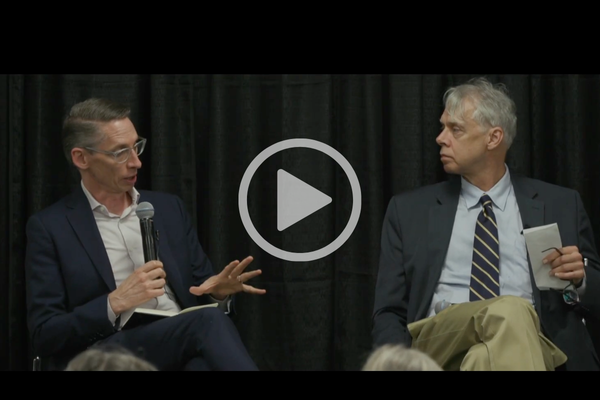
When President Sanford asked Katie what drives her work—writing, speaking, hosting a daily radio show—her answer was simple: the world needs what the Church has to offer.
Not merely arguments or commentary, but a witness to the joy of the Gospel—a vision of life grounded in meaning, purpose, and ultimately the hope of heaven.
That conviction led them into a deeper discussion about a question that is becoming more urgent in our own moment: What is education for?
Today, many people understandably view higher education through a utilitarian lens. Parents and students ask whether a degree will lead quickly to a job, or whether the cost of college can be justified by its economic return.
Those concerns are real. But if education is reduced solely to career preparation, we risk overlooking something essential.
The purpose of education is not merely to prepare someone to do a job. It is to form the human person.
This is precisely what the liberal arts tradition aims to do. By immersing students in the great works of philosophy, theology, literature, and history, a liberal arts education cultivates habits of mind that remain valuable throughout a lifetime: intellectual curiosity, clarity of thought, moral imagination, and the courage to wrestle with difficult questions.
Katie described this beautifully when she reflected on her time at the University of Dallas. Students arrive expecting to read great books and engage in serious intellectual conversation. But what they often discover is something deeper: a community where they learn how to think, speak, and pursue truth alongside others.
In that sense, a university like ours serves as an incubator for becoming a good human being.
That formation matters now more than ever.
We live in a moment when artificial intelligence can summarize books in seconds, generate answers instantly, and appear to provide knowledge without the labor of understanding. But genuine learning requires something different. It requires time, attention, and the willingness to wrestle with ideas.
As Katie observed, there is a profound difference between asking a machine for quick questions about a book and spending ten hours reading it yourself and reflecting on its arguments. The latter forms the mind in ways no algorithm can replicate.
This is why the liberal arts remain not only relevant but essential in the age of AI.
A society that hopes to flourish in the coming decades will need people who can think clearly, argue without rancor, pursue truth with humility, and engage others with genuine curiosity.
In other words, we need people who are not afraid to ask the deepest questions about what it means to live a good life.
At the University of Dallas, we often say that we aim to graduate independent thinkers. That phrase does not mean people who reject tradition or believe they have nothing to learn from the past. Quite the opposite.
It means individuals who have been formed by the best of what human civilization has produced—and who are therefore equipped to contribute something new.
The world does not need fewer people grounded in the great tradition of human thought. It needs more of them.
And as Katie’s story illustrates, when students receive that formation, they carry it with them wherever they go: into media, medicine, business, education, the arts, politics, and the life of the Church.
In the Gospel, Christ calls His followers to be salt and light in the world—to preserve what is good and illuminate what is true.
A great education prepares people to do exactly that.