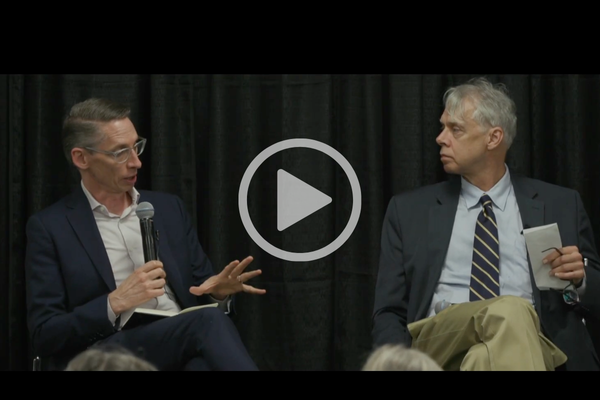
Transcript of the Conversation
Sanford: Mary, it's so wonderful to sit down with you and have this conversation. And thank you for the many ways in which you've been part of the University of Dallas for a long time, as a parent, as a trustee, as the wife of a trustee before. We've known each other a long time, so I don't want to pretend like we're just getting to know each other here. But thank you for your work, both with the University of Dallas and also at the Ethics and Public Policy Center, where you're a senior fellow. And you have been taking on some really challenging issues. What is the state of your current project? I know you've been dealing with transgenderism and the plight of young people today and the state of the family.
Hasson: Well, first, it's great to be here. Always good to have a conversation with you, and we do go way back. And it's wonderful to just be here at the University of Dallas and to have the opportunity to have a conversation. So you asked about my work. And I am focused-- I have a project called the Person and Identity Project, which really has two aims. One is to promote the truth about the human person, but then the other is to equip parents and faith-based institutions to counter gender ideology, which, as we like to educate people, gender ideology is really a challenge to the truth of the human person. And it's not just about how many kids get confused, and they're suffering, and they're taking down a wrong path. That's a tragedy. But there are a lot of very big issues connected to the corruption of the understanding of the human person.
Sanford: You know, I think people like you, like me, like others, have for a long time been wrestling with these major issues. It seems as though our civilization has been unraveling. And I'm much affected by Alistair McIntyre, who has a really remarkable way of bringing to light just how fragmented our language is around moral and ethical terminology.
This is not something new, but it does feel as though the pace of fragmentation has quickened. And I have the sense that we need to not, so to speak, pick up all of the pieces that have come apart and try to glue them back together, but rather to invest ourselves in institutions that are able to reclaim our culture. Does that make sense to you?
Hasson: Just that image of our culture having been fragmented in so many significant ways. And what it takes to go around picking up the pieces, sometimes you lose the vision of the whole of what it is that was fragmented. So I think it's got to be a twofold process where you can look at the wreckage of what we see the human difficulties that have arisen as a lot of things have fallen apart, but also the difficulty with our institutions, with our laws, with the culture. So we can see all that. But as you said, there's been a lot of time invested in critiquing and analyzing what's gone wrong. But my sense is that unless we're also thinking about, well, how do we help people see the truth, see the vision, see what we're aiming for, how do we build, we could spend the rest of our time continually analyzing what's going to continue to go wrong. And we really haven't made things better.
Sanford: Right, right. I love the fact that you've framed your project, the person and identity project. And this need to recover the truth about the human person, that was identified more than 50 years ago by John Paul II, even before he was John Paul II. The philosophical and theological works, love and responsibility, person and community, that Karol Wojtyła was articulating in the 50s and 60s and 70s, those were wrapped into a very rich theology of the body.
And one of the things that we often overlook is the contributions that John Paul II has made to how we approach education. And there's a fundamental work of education that, as it were, enables a human being to move from what he or she is into what he or she is called to be. And so when John Paul II would reflect upon K-12 education and even more significantly, at least for my work, at the university, he always points our attention to that first thing, which is the founding principle of Catholic social teaching, the dignity of the human person.
You've sent your kids to classical schools. They went to Trinity and Meadow View. I went to Trinity and South Bend. We're great promoters of the classical education movement in the United States at the University of Dallas and offer a very rich liberal education. What led you and Seamus to say, we want this kind of education for our children? Is that connected in some way to the way you think about the human person?
Hasson: Very much so. And I think also to having a sense of what was happening in the culture, and yet the beautiful-- the truth about who we are, but also the truth and wisdom that you find in the classics in Western civilization, in the writings of the great church fathers.
So when it came time for our kids looking at middle school, high school, we really wanted something that was going to help them see and desire the truth and to engage it and to engage competing ideas so that they would launch into adulthood with feet firmly grounded. I mean, everyone's got to make a choice. What do you choose for yourself? But you have to be on firm ground where you can even see the choice. And so I think for us, when our kids went to Trinity, we were inspired by the opportunity for them to be able to engage with the great works and to discuss, but not discuss in sort of a relativistic way. There's no right, there's no wrong, there's no truth. Not at all, but rather, there's so much richness and there's so much wisdom to be gained from those who have written and taught and thought about all these things. So in fact, it's really through Trinity, which had this classical approach, that we even thought of sending any of our children to the University of Dallas because it was a UD alum who was teaching at the classical high school. And she inspired, particularly our oldest, who just thrived under the classical approach in high school. And she said, oh, you've got to see University of Dallas. If you like this, you will love that. And so that started us on a journey where we've sent five kids here who have-- I can tell you they have gotten a fantastic education.
Sanford: Well, I'm really grateful to that teacher.
One of the things that is at the foundation of an approach to education that seeks to reorient the student to a kind of openness to the truth is the personal attention. You mentioned what sometimes goes by the name of viewpoint diversity. So you want your kids to be really properly argumentative. What I mean by that is knowing how to articulate somebody else's position and at the same time be able to articulate what you think is wrong with that position and then be open to their disagreement. So we've lost this art of arguing without quarreling. And I think there's something beneath that that's connected to the kind of individualized approach that is possible within a genuine liberal education, which is you need to actually care about the fundamental questions of human existence. I mean, what is a human being? But what is justice? There are competing accounts of what justice is. You encounter them through works of deep literature that make you think. But you have to care, right? And I'm saddened by the fact that a lot of young people today seem apathetic. I think they're in an environment where they think what it is to know something is to be informed about it. And nearly every young person in America today has access to all of the known information collected on this thing we call the internet.
Hasson: Or they can be content creators and create their own.
Sanford: Right. But that's not what it is to know a thing. It's not what it is to have really wrestled deeply with a question of fundamental importance to our existence. And I wonder if there's a relation between some of the challenges of identity that you look at and the kind of distance that has been created between knowing things and self-knowledge.
Hasson: So I think part of it is in a very simple way. I think back to when our oldest was looking at schools. And there was so much emphasis on education as simply preparing for a job. Right. It's acquiring the knowledge or the skills so you can go out and earn money. And that's going to be your true meaning in life, your purpose. And it certainly wasn't the message he was getting in the classical program he was in. But that was sort of the peer and cultural emphasis. And so if you're approaching education simply from a question of utility instead of asking, well, what's true and how do I live? And what am I called to do? What's my mission? What's my purpose? All of that, you have to start in a different place. But you also have to realize that as a person, you're made for something more. You're not made just to be a cog in a wheel and grind it out until you die. And that's it. Hope it was a good life. There's something deeper. So I think even just helping people realize education is not just about a job. And UD does a fantastic job of people launching and getting a good start in, whether it's grad school or their careers. Fantastic. But they come out with a sense of knowing what the truth is, having a sense of mission, that they're called to something deeper. They're called to continually be forming and educate themselves, just because that's part of what it means to be a human being. We're made in the image and likeness of God. We have intellect and will. We've got to use our intellect. We're made to search for the truth. And I think to the extent that our culture has kind of blunted that impulse in people, it's almost like the bread and circuses. You can distract people and keep them on the surface. And they don't think too deeply. And they get some measure of contentment, but it's not down deep, happiness.
Sanford: And they're made ready for the workforce. But that will last five or seven years. And then you've got to retrain them, right? But education is not mere training. And I think one of the reasons why our placement rates are as high as they are-- we're almost 100% first destination placement rates-- is because our students have learned to be creative thinkers. They're articulate. And they're eager to find ways to do big things, to make whatever institution or corporation that they're part of better. So it's a notion of the common good, which is different than being treated as part of a collective. And now you're going to serve a utilitarian end. No, I'm an individual. And I care so deeply about what's common that I want to contribute in a fundamental way through my work. And that might look the same from the outside. But I think it's a really different mentality.
Hasson: I remember when our oldest was a student here. And he was talking about the great conversations he was having with other students. And I was like, kids always say, you think to yourself. Kids always say what they think their parents want to hear. But I remember on our first visit, there wasn't a formal occasion. It just came to visit him. And going down to the cap bar, getting a cappuccino. And sure enough, there were multiple groupings of kids who were just engaged in these conversations about something they'd heard in class. Or it just seemed like an idea that had captured their questioning mind. And they really wanted to wrestle with it with some-- I was amazed because it wasn't something--It wasn't staged. It wasn't forced. It came out of what they were experiencing in the classroom. And I think also just the like-minded peers.
If you're in a group of people and everyone's in different-- everyone's looking at the watch and everyone's scrolling on their phone, that's going to affect your own attitude of curiosity and openness. But if you're in an environment where the professor is expecting that you want to know this, you need to know this, and your peers have that same attitude, you don't just go to class, take it in, close the book, and leave. You take it in, and you're digesting, and you're discussing. And I think with UD's core, one of the things that is so advantageous about that is it's a common body of knowledge. So our kids have had friends who were physics majors or in the pre-professionals, others who were theology. It didn't matter. They all had a core body of knowledge, courses that they had to take. And that was amazing because it really inspired so much. And everyone's captured by the same ideas. Anyway, I'm enthusiastic about that. It really--
Sanford: Well, I mean, the culture matters. And even if you're a relatively small culture, it matters. And it can sustain you as you go out into broader culture.
When you consider the challenges within our broader culture, what does surmounting those challenges look like? What does-- I don't want to frame it in terms of success because that often conjures a zero sum approach. And we're all at war with each other. And there are ways in which those metaphors are appropriate. And I wonder if we ought to be thinking beyond them. So when you imagine a reclaimed culture, a rebuilt Western civilization, a thriving America, what are the key points that you call to mind?
Hasson: So I think you work with your institutions-- family, church, university. Universities certainly are your thought leaders. And we can see that, actually, if you look back in history, where things started to go off the rails, a lot of it was because of what was happening in academia, throughout truth, throughout a sense of trying to encourage virtues and encourage students to think more deeply. But within a sense that acknowledged that there is a truth, there is wisdom, there's something good there to be grasped. And so we can see what happens when that goes off the rails. So I think universities are very much a part of that solution. But I think more broadly, if you're going to rebuild the culture, you have to have a vision. What is it that you're building towards? And that's something where you're going to get that. So some of it is from your family and your faith. But certainly, as I said, the universities and the thought leaders. You also need people. It's very hard to change the mind or the approach of someone who's my age. Whereas if you take someone who has been trained and educated in a mindset, they're equipped to be able to go out and to make that vision a reality. So I think those are some key elements.
Sanford: And learning how to do that is not something that you can cut corners around.
Hasson: And it takes time.
Sanford: It takes time. So if we had political leaders and religious leaders say, you all need to listen more carefully to each other and stop disagreeing all the time. That's not going to be effective. And they have said versions of that. One way I think about what happens within a well-run school, K-12 or university, a well-run classroom is you are engaged in developing those habits that enable you to be a careful listener, a good arguer, somebody who can think for yourself, think independently, somebody who nurtures a kind of curiosity, who's learned to persevere in pursuit of things that you know you don't know. And you only know you don't know something if you're willing to acknowledge your own. So it takes some humility. Those are virtues that really can be acquired through excellent pedagogy in the classroom.
Hasson: But I would add to that just the idea of respect, the fact that if your professor respects you and engages you with respect and you have to model and engage with others, even those with whom you vehemently disagree, for example, on a particular point, that's something you don't just leave in the classroom. That becomes part of who you are because we're always going to have very serious disagreements. Polarity and division that we see in our society, in a sense, isn't surprising because there's a gulf between good and evil. And I'm not saying everyone I disagree with is evil, but rather around some ideas. There are clear things that are good and things that are destructive, particularly to the human person or to the family or to the culture at large. And so you see those things. It's not surprising that you're going to have some division in polarity, but how do you engage that without having it become something that's destructive of you, where you lose your integrity? And I think, again, as you said, you become habituated to that. First, you have to see what you're aiming for, but you have to understand who it is you should be aspiring to be, what kind of a human being. What are the virtues of a well-formed mind, a well-formed character?
Sanford: In me, a vision of what it is to live nobly. And one of the signs of hope that I see in young people today-- and there's some sociological data that backs this up-- is there's a hunger for meaning. There's a hunger for deep roots. It's still small, but a growing trend of people recovering deep religious roots-- Jewish, Catholic, Orthodox. They want the real stuff, not the fluffy stuff.
And I think this is a moment where institutions really need to do the hard work of applying those time-tested pedagogical practices that are going to expose students to the pitfalls sometimes when they're wanting to look deep.
So go back to this notion of young people want to live nobly, and thinking particularly of some research I've seen on young men. So the phenomenon of juvenile boys who are attracted to the likes of Andrew Tate, or take your pick, but people who have a vision of what it is to be strong and manly that is fundamentally disordered. But you find this-- it's honor, it's power, it's pleasure. Those are the temptations of what we can take the good life to entail. Aristotle and Aquinas, for instance, they both wrestle with those views of the good life at the outset of their reflections on ethics. And there is something attractive about strength and power.
So how do we harness that desire for something that is noble and good, and convince young people, and not just young men, young women, it's going to take a lot of work. And we don't want to kill that desire. We don't want to say, no, just be useful to society. Just do something that's going to help the GDP or whatever. No, we want to foster that spiritedness and that desire both to go deep and to reach far in their aspirations, but make sure that they don't fall into these temptations to imitate those who are projecting false views of that way of living.
Hasson: I think some of those influencers who clearly, as you said, are disordered or they're projecting a false vision, I think they become attractive because they're clear, they're firm, they're willing to lead. Unfortunately, many of them lead in the wrong direction. But I think that comes back to helping young people realize, you're made for a purpose. And there's a mission to your life. And what we do here as a university is going to help you find that. It's going to help you find that meaning and purpose in your life.
I saw a study that Harvard Graduate School of Education published about a year and a half ago. And they interviewed young people, Gen Z, who were very-- well, successful. In other words, they weren't the ones who failed to launch, like they were in their mom's base. They were kids who had young people who had a job who were, by all accounts, doing well. And yet when they interviewed them, they found that 58% of them said that in the last month they really struggled because they had no sense of meaning and purpose.
And they had various quotes. And all I could think of was, how difficult to get up every day and do the same thing over and over if you don't know why. If you don't know what's this for, other than to fill my bank account so I can go buy stuff and go do-- ultimately, it's not satisfying to the human person.
But if you're arriving at your mid-20s and you have not, up to that point, sought out a deeper purpose or even questioned whether there should be one, it's a lot harder. You're going to suffer a bit in that quest to find it. Whereas when you have young people, for example, who arrive on a college campus, it's a natural point of curiosity. If you can help them see that vision and begin to ask those deeper questions about the culture, about truth, about themselves, and to find that meaning and purpose, well, then you've done something.
Sanford: I used to find very inadequate this definition of the good life for a man, that McIntyre gives near the end of After Virtue. He says the good life for a man is the life spent seeking the good life for a man. And I thought, can we go a little bit further than that? But I've come to appreciate the depth of that insight. And it's connected to what you just articulated.
There's purpose that can be found in striving to find your purpose. And I think sometimes we can think--answers to what life is all about is like going to the cafeteria. And you can choose what seems to fit, where your appetite is. And that's a very unsatisfying way to proceed, because you need to have wrestled with earlier questions about, well, what sort of thing will actually be good for me? What is most fitting? And that needs to provide some kind of direction in terms of what you select.
Hasson: Makes me think of bad advice I've heard given to young people who are told, just follow your passion. And I think, to use your cafeteria example, if you go into a cafeteria and you don't have any sense of nutrition, what my body needs, what's going to give me strength and help me be healthy, so I can do the things I want to do, you're just going to follow your passion and drink all of the coke and eat all of the-- whatever it is, pizza or chocolate cake or whatever it might be-- it's going to be destructive.
So learning the role, how our passions should integrate into our life, the role of reason, character, virtues, having a clearer sense of that allows you to understand what it means when you're enthusiastic or inspired by something.(...) But yet, how are you saying, just an enthusiasm for the moment or is there something more here to look into or whatever? So it's the difference between eating a really wonderful meal that's completely balanced but delicious and just snacking on fast food all day where you never get to the substance.
Sanford: And at the risk of extending a metaphor too long, I'm thinking about the difference between going to a restaurant or a cafeteria and selecting things and cooking your own meal and developing those practices that are in service of the ends of something that's going to have deep nutritional value and taste good and be conducive to great conversation around the table. And so living a good life is like learning how to cook well where you've tried different things out, but they're all aimed towards that trifecta of nutritious, delicious, and conducive to conversation.
Hasson: And it's to be shared, right? And so I think the search for knowledge and education is something like that too. You need fellow travelers. You need others to challenge you and to commit. Like, do this and not that.
Sanford: So to reclaim our culture, we need more cooks in the kitchen.
Hasson: We need more thoughtful universities. We need more places like UD that really cultivate that sense with respect and dignity. You are made for something more. You know, come here. We'll help you find it.
Sanford: So it's, I think, important for us to remember that our Lord started with a very small group of apostles and other followers. And they were not perfect men. And a lot of challenges that we just get little glimpses of in their lives. And yet they were on fire. They were transformed. And it's not that they went out and persuaded everyone to live differently. They presented a vision of the good life. They presented a vision of how to think about one's own destiny. And a way of living that was beautiful and compelling because of its beauty, deep respect for the dignity of other human beings, the significance of the family. These Christians refused to expose their deformed children. And eventually, they built hospitals and universities and built up our civilization. We don't need to--good policies are always important. Good laws are always important. But the individuals who are transformed by a really rich education, who learned to live into that education throughout their lives. And I think they will be the chief architects of a reclaimed culture.
Hasson: Can you agree more? I think that's the key.
Sanford: Well, thanks so much for joining me in this conversation. It's always good to see you. Wonderful to be with you.