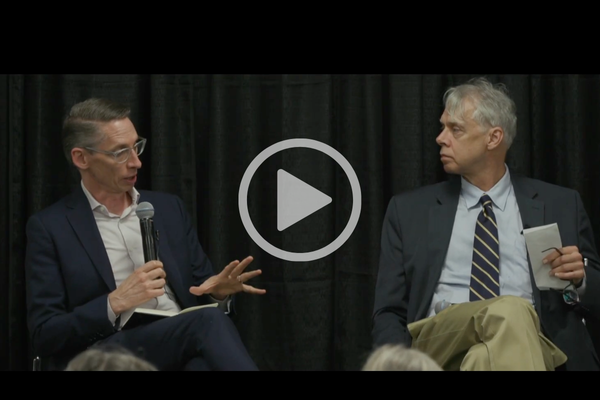
Transcript of the Conversation
What follows is an adapted transcript (edited for length and clarity) of the discussion.
Sanford: George, it’s a joy to have you with us. You’ve been connected to UDallas for years—and as you’ve said, you’re a “big UD guy.”
Weigel: I am. Two of my daughters graduated from the University of Dallas—and my grandson is here now, thriving.
Sanford: So let me begin simply: why did you want your daughters—and now your grandson—to come to UDallas?
Weigel: Because this University takes liberal arts education seriously—and it takes it seriously in a Catholic liberal education key. That kind of education prepares young people for anything because it forms souls and minds, character and intellect—not just résumés.
Sanford: That’s the heart of the matter. And yet “liberal arts” is often mocked today—either as impractical or as cover for ideological activism. Many people assume every campus has “gone the way of Harvard” or “gone the way of Columbia.”
Weigel: Part of the issue is that some elite institutions stopped taking truth seriously. You can see it in the shift from truth as something real to truth as merely an aspiration. And when a university stops believing in truth—students end up with the prestige of an institution but without the inheritance of a civilization.
Sanford: And that has consequences far beyond the classroom. A culture that loses confidence in truth can’t sustain serious moral reasoning.
Weigel: Exactly. And parents too often buy the myth that if their child doesn’t attend a handful of elite schools, they’re “ruined for life.” But the graduates of places like UDallas refute that every day.
Sanford: There’s also a distinct temptation in Catholic higher education: some institutions tried to preserve academic excellence by loosening their Catholic identity, and others tried to preserve Catholic identity by lowering the intellectual bar. Both are mistakes. True Catholic universities must pursue excellence precisely because they are Catholic.
Weigel: And that’s why John Paul II matters here—especially his teaching in Fides et Ratio: “Faith and reason are like two wings…” on which the human spirit rises toward truth. (That image remains foundational.)
Sanford: At UDallas we sometimes describe that integration as faith interwoven into the intellectual life, not stapled onto it.
Weigel: And in a moment like ours, a genuine core curriculum—the great works of Western literature, philosophy, history, and religious thought—is not optional. It’s more critical than ever, because we’re living in a civilizational crisis in the Western world.
Sanford: When you say “civilizational crisis,” what do you mean?
Weigel: I mean this: if the only defense we can offer for Western ideals—human rights, limited government, ordered liberty, and the dignity of the person—is “it works better,” we won’t be able to defend it for long. To defend the West, students must spend formative years wrestling with the ideas that flow from Jerusalem, Athens, and Rome—the roots of Western civilization.
Sanford: So the question isn’t only “what jobs will students get?” It’s whether they’ll have the intellectual and moral resources to preserve what’s best in our civilization—and to renew it.
Weigel: Right. There are rival civilizational projects in the world. And if we haven’t read deeply—if we haven’t wrestled with Homer, Virgil, Dante, Augustine, Plato, Aristotle, Aquinas—then we won’t be able to articulate what we’re defending, or why.
Sanford: That raises the question: can you sustain the West’s literature and moral vision while cutting faith away from it?
Weigel: If you cut Jerusalem off from Athens and Rome, you eventually lose the biblical foundation for believing the world is intelligible—that reality has a knowable structure. When reason doubts its ability to reach truth, everything becomes “your truth” and “my truth.” And then power rushes in to settle disputes—what Cardinal Ratzinger called the “dictatorship of relativism.”
Sanford: And this is where the purpose of education becomes unavoidable. Education is not merely information transfer. It’s formation—formation for truth, virtue, and human flourishing.
Weigel: And the history of science itself supports this integration. Some of the most consequential scientific insights of the modern world came from Catholic priests who did not think they lived with “split minds”—men like Gregor Mendel and Georges Lemaître.
Sanford: Yet we still face a knee-jerk utilitarianism: “Why read books? Why study abroad? Why wrestle with hard questions—when we can just download information?”
Weigel: Catholic institutions need to tell their story better. We have to explain—concretely—how this kind of liberal arts education prepares students to do anything and everything.
Sanford: There’s another challenge you raised that hit me: we’re becoming a post-literate culture.
Weigel: Yes. And a post-literate society becomes a post-rational society. When people don’t read, public life devolves into slogans and insults. Our founders could build durable institutions because they shared a common Western civilizational vocabulary—a common grammar shaped by Scripture, law, and philosophy. We don’t have that shared vocabulary today, and our politics becomes rancid as a result.
Sanford: And beyond politics, we see widespread misery—people chasing fame, power, wealth, and honor as if those were the only routes to happiness, only to wake up later realizing they don’t know what they’re living for.
Weigel: Human beings are made to worship. If they don’t worship the true God, they will worship false gods. But here’s a note of hope: many young people are finding their way into the Catholic Church because they’ve felt the emptiness of the dominant culture—and they’re reaching again for the transcendent.
Sanford: And when they do, I hope they discover that the path of renewal includes the Church’s worship and teaching—and the canon of Western civilization.
Weigel: Exactly.